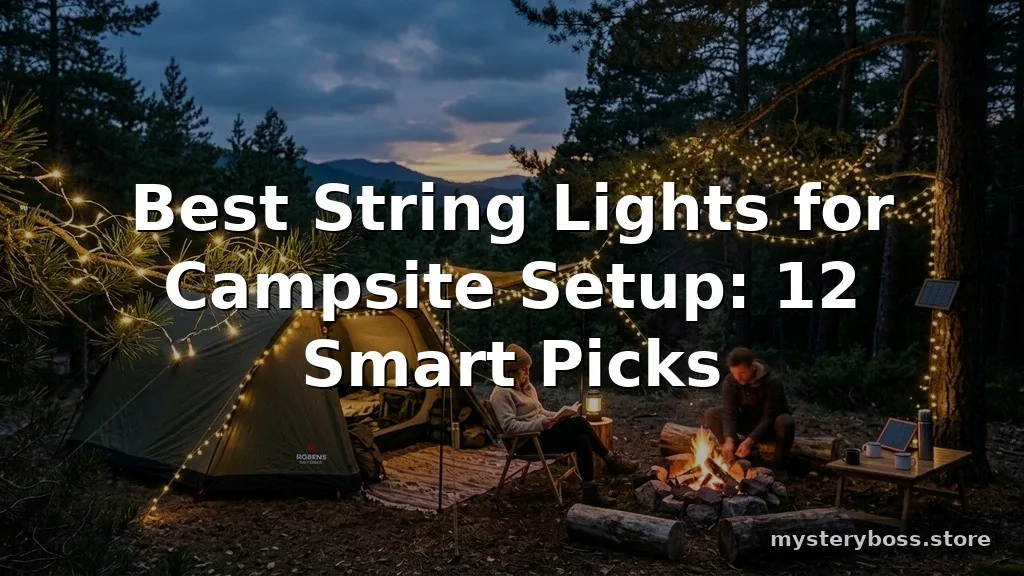
The best string lights for campsite setup should do more than look attractive around a tent. They need to provide enough light for cooking, finding gear, and moving around safely without taking up too much space in your pack. Power source, weather resistance, hanging options, brightness control, and rechargeability all make a noticeable difference outdoors.
Some designs suit car camping and family sites, while others are better for backpackers who need a compact lighting system. Below, you’ll find practical campsite string-light ideas, a comparison of their strengths, setup advice, and the key trade-offs to consider before buying.
How to Choose String Lights for a Campsite
Start with the way you camp. A long decorative strand can create excellent coverage around a picnic table or awning, but it may be excessive for a solo backpacking trip. Compact LED lights with a rechargeable battery are easier to pack, while solar-powered options can reduce the need for cables if they receive enough daylight.
- Power source: Choose USB, a built-in rechargeable battery, solar charging, or replaceable batteries according to your access to power.
- Brightness: Look for adjustable modes so the lights can provide soft ambient lighting or brighter task light when needed.
- Length and coverage: Measure the tent, tarp, awning, or campsite area before choosing a strand.
- Weather resistance: Check the manufacturer’s stated protection rating and keep charging ports covered around rain and condensation.
- Weight and packed size: Backpackers should prioritize compact designs, while car campers can carry longer strands and larger battery systems.
- Hanging system: Clips, loops, magnets, or integrated hooks make setup faster and reduce the need for extra cord.
- Light colour: Warm white creates a relaxed atmosphere, while cooler white can make cooking and organizing gear easier.
🛠️ Practical Tip
Pack a small repair pouch with spare clips, lightweight cord, and a waterproof bag. Even a well-designed light strand is easier to manage when you have a backup way to secure it.
Best String Lights for Campsite Setup: Comparison
The options below are organized by the way they are powered and used. They are lighting configurations rather than claims about one specific brand or model, because exact battery capacities, lengths, materials, and water-resistance ratings differ between manufacturers. Use the table to narrow down the design that fits your campsite.
| Option | Best For | Power Style | Main Strength | Main Drawback |
|---|---|---|---|---|
| 1. Solar Micro-LED Strand | Car camping | Solar panel | Low-maintenance ambient light | Depends on sunlight |
| 2. Solar Lantern Strand | Relaxed campsite lighting | Solar charging | Decorative lantern design | May be bulkier to pack |
| 3. Rechargeable Globe Strand | Family campsites | Built-in battery | Broad, comfortable glow | Usually less packable |
| 4. Solar Rope Light | Walkways and awnings | Solar charging | Continuous visual line | Limited directional lighting |
| 5. USB Micro-String Set | Backpacking | USB power | Lightweight and compact | Needs a power bank |
| 6. Power-Bank String Light | Flexible travel use | USB battery bank | Can share power with devices | Uses stored battery capacity |
| 7. USB Clip-On Strand | Fast tent setup | USB power | Easy attachment | Clips may suit only thin edges |
| 8. USB Retractable Strand | Organized car camping | USB power | Neater storage | Housing adds weight |
| 9. Warm Edison-Style Strand | Camp kitchens and patios | USB or battery | Strong visual atmosphere | Bulbs can be delicate |
| 10. Multicolour Party Strand | Group campsites | Battery or USB | Customizable mood lighting | Less discreet for quiet sites |
| 11. Emergency Beacon Strand | Backup lighting | Rechargeable battery | Useful safety modes | Not always the most decorative |
| 12. Tent-Line Marker Lights | Trip hazards and boundaries | Battery or solar | Improves visibility around lines | Limited area illumination |
💡 Tip
Treat the table as a starting point rather than a specification sheet. Confirm strand length, charging method, runtime, water resistance, and included mounting hardware on the individual product page.
Solar and Rechargeable Campsite Lighting
1. Solar Micro-LED Strand

A solar micro-LED strand is a practical choice for car campers who want a soft line of light around an awning, tarp, or picnic table. Its thin wire and small LEDs typically pack more easily than globe bulbs, while a separate solar panel can be positioned toward the sun during the day. The main limitation is predictable: cloudy weather or a shaded campsite may leave less energy available after dark.
Pros
- Suitable for decorative perimeter lighting.
- Doesn’t require a wall outlet or separate power bank.
- Thin construction can store neatly in a small pouch.
Cons
- Charging performance depends on daylight and panel placement.
- Small LEDs may not provide enough light for cooking or reading.
✨ Style Tip
Place the solar panel where it can receive afternoon sun, but run the light strand under cover if rain is expected. The panel and lights don’t have to occupy the same position.
2. Solar Lantern Strand
Solar lantern strands use individual covers around the LEDs, giving a campsite a more defined and decorative look than bare wire lights. The lantern shapes can help spread light in several directions, making them pleasant around a communal seating area. They are generally more suited to car camping than backpacking because the covers and panel may take up additional space.
Pros
- Creates a noticeable campsite glow.
- Lantern covers can soften harsh LED light.
- Useful for seating areas and outdoor entertaining.
Cons
- Lantern housings may be awkward in a small backpack.
- Solar charging is still affected by shade and weather.
💡 Tip
Use lantern-style strands above eye level or along the back edge of a table. This keeps the bulbs from shining directly into people’s faces.
3. Rechargeable Globe Strand
A rechargeable globe strand is built for atmosphere and broad light coverage rather than minimum weight. Larger bulbs can make a picnic table, camp kitchen, or sheltered porch feel more comfortable after sunset.
Look for flexible cable construction, protected charging ports, and a battery indicator if available. This type often makes more sense for frequent car campers than hikers.
Pros
- Produces a wider, softer glow than tiny indicator LEDs.
- Works well over dining and social areas.
- Rechargeable operation avoids disposable batteries.
Cons
- Bulbs and cable may be heavier than micro-string designs.
- Bulky bulbs need careful storage to prevent damage.
🛠️ Practical Tip
Store the strand in a loose coil rather than winding it tightly around your hand. A small fabric bag or original storage case can keep the bulbs from rubbing against cookware.
4. Solar Rope Light
Solar rope lights place LEDs inside a continuous flexible tube, creating an even line along a tent entrance, awning, or walkway. The enclosed design can be easier to wipe clean than exposed bulbs, although the manufacturer’s outdoor-use rating still matters. Rope lighting is best for marking edges and creating coverage, not for illuminating detailed tasks.
Pros
- Provides a consistent outline around a campsite feature.
- Flexible shape suits rails, awnings, and low boundaries.
- Enclosed LEDs can be easier to handle during setup.
Cons
- Often less bright in one direction than a lantern or lamp.
- May be harder to pack compactly than thin wire.
✨ Style Tip
Run rope lighting along the outside edge of an awning rather than across the center. You’ll create a clear visual boundary without making the space feel overly bright.
USB and Power-Bank String Lights
5. USB Micro-String Set
USB micro-string lights are among the most packable options for backpackers and minimalist campers. They can run from a power bank, vehicle USB port, or another compatible USB source. Their small LEDs are useful inside a tent, around a sleeping area, or beneath a tarp, but they may not provide enough brightness for food preparation.
Pros
- Compact enough for lightweight travel.
- Can use a power bank already carried for electronics.
- Flexible wire works around poles and guy points.
Cons
- Requires a separate USB power source.
- Fine wire may need careful packing and handling.
💡 Tip
Keep the power bank inside a dry pouch with the cable exiting through a small opening. This reduces exposure to damp ground and helps prevent the connector from being pulled loose.
6. Power-Bank String Light
A power-bank string light combines lighting and portable charging in one system. That can be useful on longer trips where phones, GPS devices, and lights all compete for battery capacity. Check whether the light can operate while the power bank is charging and whether its controls are easy to find in the dark.
Pros
- Combines a light source with device charging.
- Useful for car camping and travel where USB power is common.
- Can reduce the number of separate items in a gear bin.
Cons
- May be heavier than a light-only strand.
- Running other devices can shorten lighting time.
🛠️ Practical Tip
Set a battery priority before leaving: reserve enough power for emergency communication, then use the remaining capacity for decorative lighting.
7. USB Clip-On Strand
A USB clip-on strand is designed for quick installation. Integrated clips can attach to a tent seam, awning edge, mesh pocket, or thin cord without requiring separate hooks. This design is helpful for beginners who want a fast setup, but you should check the clip opening before buying because some are made for narrow fabric edges rather than thick poles.
Pros
- Fast to hang and remove.
- Reduces the need for tape or extra cord.
- Works well inside tents and beneath awnings.
Cons

- Clip compatibility varies.
- USB cable placement may limit where the strand can go.
💡 Tip
Clip the strand to structural points rather than loose tent mesh. That spreads the load and lowers the chance of snagging fabric when people move around inside.
8. USB Retractable Strand
A retractable strand is aimed at campers who dislike tangled cables. The housing keeps the line contained when packed, and the light can be pulled out to a useful length at camp. This all-in-one design is convenient for car camping, travel, and emergency kits, although the reel or casing adds bulk compared with a simple loose strand.
Pros
- Stores neatly with less cable management.
- Length can be adjusted for small spaces.
- Convenient for repeated weekend use.
Cons
- Retractable mechanisms add another part that can fail or jam.
- Usually less flexible for wrapping around large areas.
🛠️ Practical Tip
Pull the cable out smoothly and avoid letting it snap back at full speed. Controlled retraction helps keep the line from crossing over itself inside the housing.
Decorative and Safety-Focused Options
9. Warm Edison-Style Strand
Warm Edison-style lights are chosen mainly for their appearance. Their amber-toned glow can make a camp kitchen, picnic shelter, or vehicle awning feel inviting without producing the stark look of cool-white LEDs. They suit established campsites and short drives more than ultralight trips, especially when the bulbs are larger or protected by decorative housings.
Pros
- Creates a relaxed, warm campsite atmosphere.
- Works well around tables and sheltered seating.
- Decorative design can complement a travel or overland setup.
Cons
- May offer less useful task light than neutral-white LEDs.
- Decorative bulbs can require more careful storage.
✨ Style Tip
Pair warm decorative lights with a separate brighter headlamp or lantern. The strand can handle atmosphere while the other light handles cooking, repairs, and navigation.
10. Multicolour Party Strand
Multicolour lights are a fun option for group camping, festivals, and private sites where a stronger visual presence is welcome. Many designs offer several colour modes or transitions, but flashing patterns may be distracting in shared campgrounds. A dim or static mode is more useful for ordinary evening lighting.
Pros
- Adds colour and personality to a campsite.
- Suitable for celebrations and group gatherings.
- Different modes can change the atmosphere.
Cons
- Bright or flashing settings may disturb nearby campers.
- Colour modes are not always ideal for practical tasks.
💡 Tip
Use a steady, dim colour setting after quiet hours and aim the strand toward your own campsite. Courtesy matters, especially when sites are close together.
11. Emergency Beacon Strand
An emergency beacon strand prioritizes visibility and backup use over decoration. It may include a flashing mode, red light, or a brighter setting that helps mark a shelter, vehicle, or gear area. Because controls and battery condition matter in an emergency, choose a design that can be operated quickly and store it where it is easy to reach.
Pros
- Can provide useful backup visibility.
- May include signalling or low-light modes.
- Helpful in a vehicle emergency kit or basecamp box.
Cons
- May not create the softest or most attractive campsite glow.
- Extra modes can make controls less intuitive.
🛠️ Practical Tip
Test the control sequence before the trip and keep the battery charged. A light with a useful emergency mode is only valuable if you can activate it quickly.
12. Tent-Line Marker Lights
Tent-line marker lights are small lights intended to make guy lines, tent corners, and low obstacles easier to see. They don’t replace a main lantern or headlamp, but they can reduce the chance of walking into a line after dark. Their small size makes them a reasonable addition for family campsites, festival camping, and busy basecamps.
Pros
- Improves visibility around tent lines and boundaries.
- Lightweight and easy to position.
- Useful for campsites with children or frequent foot traffic.
Cons
- Provides very limited area lighting.
- Small units can be misplaced during packing.
💡 Tip
Place markers at eye-catching points such as tent corners and the middle of long guy lines. Avoid placing them where they can be stepped on or caught by vehicle doors.
How to Hang Camping String Lights Safely
Good hanging technique keeps lights visible without stressing the tent, tarp, cable, or mounting points. Use existing loops, awning rails, poles, or separate lightweight cord where possible. Avoid attaching a heavy strand to unsupported mesh, and keep cables away from cooking flames, vehicle wheels, and walkways.
- Choose the area that needs light, such as a table, tent entrance, or awning edge.
- Identify secure attachment points before uncoiling the strand.
- Place the power source in a dry, stable location.
- Hang the lights high enough to avoid head contact but low enough to provide useful coverage.
- Check that no cable crosses a walking route unless it is clearly protected or marked.
- Use the lowest brightness that provides sufficient visibility.
- Pack the strand dry and inspect the cable before storing it.
For general campsite etiquette and ways to reduce unnecessary disturbance around wildlife, review the Leave No Trace guidance on respecting wildlife. Bright lights should be directed toward your own camp rather than into surrounding vegetation or neighboring sites.
🛠️ Practical Tip
Photograph your light layout before taking it down. The image can help you remember which clips and attachment points worked best at that campsite.
Choosing the Right Option for Your Camping Style
For backpackers
Choose a USB micro-string set or another compact LED strand that works with a power bank you already carry. Keep the lighting modest and avoid large bulbs, heavy reels, and bulky lantern covers unless the extra comfort is worth the pack weight.
For car campers
Car campers have more freedom to choose longer strands, globe bulbs, solar panels, or retractable systems. Focus on weather protection, easy storage, and enough coverage for the table or awning rather than chasing the lightest possible design.
For families
Tent-line markers, clip-on lights, and warm globe strands can work well together. Marking trip hazards is often more useful than making the whole campsite extremely bright, especially around tents and cooking areas.
For frequent weekend campers
A rechargeable or retractable system may justify its extra complexity because it can be packed and set up repeatedly. Look for controls that are easy to find, a charging port with a secure cover, and a storage method that prevents tangles.
💡 Tip
Don’t use decorative lights as your only source of illumination. A headlamp or dependable lantern remains the better tool for repairs, walking beyond camp, and handling emergencies.
Frequently Asked Questions
What are the best camping string lights?
The best option depends on your campsite and power access. USB micro-lights suit backpackers, solar strands work well for sunny car-camping trips, and rechargeable globe or lantern designs are better for comfortable group spaces.
How do you hang string lights at a campsite?
Use tent loops, tarp edges, awning rails, poles, or separate lightweight cord. Keep the strand away from flames and walking routes, and don’t put unnecessary tension on mesh or unsupported tent fabric.
How many lumens are needed to light a campsite?
There is no single ideal figure because coverage, beam direction, and light colour affect perceived brightness. A string light usually works best as ambient lighting, supported by a brighter lantern or headlamp for cooking and detailed tasks.
Are rechargeable camping lights better than solar lights?
Rechargeable lights are more predictable when you can access USB power or a charged power bank. Solar lights reduce cable dependence but may deliver less consistent performance after cloudy days or in shaded campsites.
Are retractable camping string lights worth considering?
They can be useful for people who set up often and want faster storage with fewer tangles. The trade-off is added housing weight and a mechanism that may be less flexible than a simple loose strand.
Final Verdict
The best string lights for campsite setup depend on the balance between brightness, portability, power, and atmosphere. Backpackers will usually benefit from compact USB micro-lights, while car campers can choose solar, globe, rope, or retractable designs for broader coverage. Families may get more practical value from clip-on strands and tent-line markers than from decorative bulbs alone.
Before buying, confirm the actual length, runtime, charging method, weather rating, mounting system, and packed size. Pick lighting that supports your campsite rather than replacing a proper headlamp or lantern, and you’ll get a setup that is easier to use, safer to hang, and better suited to the way you camp.
Leave a Reply