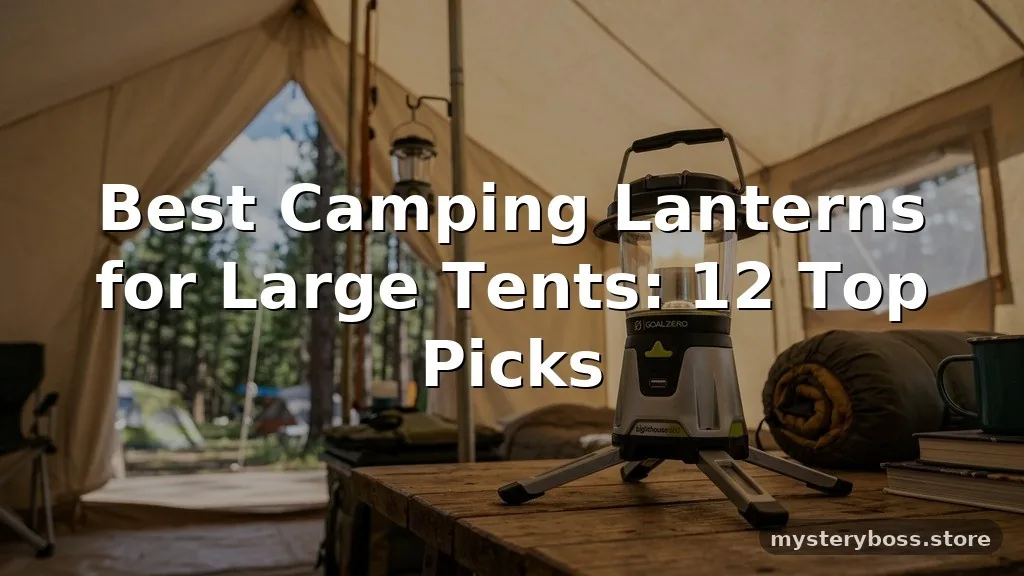
A large tent needs more than a small reading light. The best camping lanterns for large tents spread usable brightness across a wide interior, run long enough for the evening, and remain easy to move, hang, or recharge. A lantern that looks bright at the campsite may still leave corners dark inside a family tent, while a high-output model can drain batteries quickly.
This roundup compares lanterns for car camping, family trips, emergency use, and portable lighting. You’ll see how Goal Zero, BioLite, Black Diamond, LuminAID, and other options differ in output, power sources, portability, controls, and runtime so you can choose based on your tent size and camping style.
How to Choose the Best Camping Lanterns for Large Tents
Large tents usually benefit from a broad light source rather than a narrow beam. Look for a lantern with adjustable brightness, a stable base, a hanging hook or loop, and enough output to illuminate the central living area without creating harsh glare.
- Brightness: Higher lumen output is useful for big interiors, but adjustable modes help conserve battery power.
- Power source: Rechargeable batteries reduce disposable waste, while replaceable batteries can be easier to manage on longer trips.
- Runtime: Check the stated run time at different brightness settings, not only the maximum figure.
- Hanging options: A lantern suspended from the tent ceiling usually spreads light more evenly than one placed on the floor.
- Weather resistance: A water-resistant design is helpful around damp ground, condensation, and sudden showers.
- Portability: Car campers can carry larger lanterns, while backpackers may prefer compact solar or USB models.
- Extra functions: USB charging, a power bank, red light, or a built-in flashlight can add useful flexibility.
For guidance on safe battery handling and portable power equipment, consult the National Fire Protection Association’s lithium-ion battery safety information.
Quick Comparison of Lanterns for Large Tents
| Product | Best For | Power Type | Notable Feature | Main Drawback |
|---|---|---|---|---|
| Goal Zero Lighthouse 600 | Bright central tent lighting | Rechargeable USB and hand crank | High output with multiple charging options | Larger and heavier than compact lanterns |
| BioLite AlpenGlow 500 | Comfortable ambient lighting | Rechargeable USB | Warm and cool light modes | Not the smallest option for backpacking |
| Black Diamond Apollo | Compact car camping | Rechargeable battery with backup options | Adjustable brightness and hanging design | Moderate rather than maximum output |
| LuminAID PackLite Max 2-in-1 | Solar backup and travel | Solar and USB | Flat-pack design with phone charging | Solar charging depends on sunlight |
| MPOWERD Luci Outdoor 2.0 | Lightweight supplemental lighting | Solar | Inflatable, compact construction | Lower output than large powered lanterns |
| Coleman Classic Recharge 1000L | Large family tents | Rechargeable battery | High maximum brightness | Bulkier for carrying long distances |
High-Output Lanterns for Large Family Tents
1. Goal Zero Lighthouse 600

The Goal Zero Lighthouse 600 is designed for campers who want strong general lighting from one main lantern. Its adjustable output, directional lighting options, USB charging, and hand-crank backup make it especially practical for family camping and emergency kits. The design is more substantial than a small backpacking lantern, but that extra size supports a higher lighting capacity and a stable presence inside a large tent.
Pros
- High maximum output for illuminating a broad tent interior.
- Multiple ways to recharge, including USB and hand-crank power.
- Useful as a central lantern or an emergency light.
Cons
- Its larger body takes up more packing space.
- Maximum brightness will reduce run time more quickly than low modes.
💡 Practical Tip
Hang the Lighthouse near the tent’s highest central point and use a lower setting for meals or conversation. This reduces shadows without wasting the battery on full power all evening.
2. Coleman Classic Recharge 1000L
The Coleman Classic Recharge 1000L is aimed at campers who prioritise maximum brightness over compact packing. Its high-output setting can suit a large family tent, screened shelter, or campsite table, while lower modes are more appropriate for reading and relaxing. Because it is a bigger lantern, it makes more sense for car camping than for long backpacking trips.
Pros
- Very bright maximum setting for spacious tents and outdoor areas.
- Rechargeable design avoids relying solely on disposable batteries.
- Useful as a primary campsite light.
Cons
- Bulk and weight limit its appeal for lightweight travel.
- High output can shorten the usable run time between charges.
✨ Style Tip
Use a bright lantern outside the tent for cooking or packing, then reduce it indoors. A lower setting is usually more comfortable against light-coloured tent walls.
3. UST 700 Lumen W-946 Lantern
The UST 700 Lumen W-946 Lantern offers the kind of output that can work well in a larger tent without moving into the most specialised emergency-light category. Its broad lantern format suits table use, while adjustable settings help balance brightness and battery consumption. It is a sensible option for campers who want a straightforward high-output light rather than a lantern filled with extra functions.
Pros
- Strong output for a family tent or outdoor cooking area.
- Adjustable modes provide more control over power use.
- Traditional lantern shape is easy to position on a table.
Cons
- May be less convenient to carry than a compact rechargeable model.
- Buyers should verify the current battery configuration before purchase.
🛠️ Practical Tip
Before a trip, check whether the selected version uses rechargeable or replaceable batteries. Packing a spare power source matters more with a lantern that serves as your campsite’s main light.
4. Energizer LED Camping Lantern
An Energizer LED camping lantern can be a practical choice for buyers who prefer familiar battery-powered equipment and simple controls. Depending on the model, output and features vary, so check the exact lumen rating, battery type, water resistance, and runtime before ordering. Larger models can provide useful general lighting for a tent, while smaller versions work better as secondary lights.
Pros
- Simple operation suits beginners and occasional campers.
- Replaceable batteries can be useful away from mains power.
- Often available in several sizes and output levels.
Cons
- Exact performance depends heavily on the model number.
- Disposable batteries add weight and ongoing replacement costs.
💡 Tip
Don’t choose an Energizer lantern by brand name alone. Compare the exact lumen output and battery runtime because compact and full-size versions can serve very different tent-lighting needs.
Rechargeable Lanterns for Comfortable Tent Lighting
5. BioLite AlpenGlow 500
The BioLite AlpenGlow 500 is a strong fit for campers who want useful brightness with a more comfortable atmosphere. It offers adjustable white light, warmer tones, colour options, and a candle-flicker-style mode, making it less harsh than a permanently bright utility lantern. USB charging and a built-in battery make it convenient for car camping, base camps, and family trips.
Pros
- Up to 500 lumens provides substantial light for many large tents.
- Warm and cool modes make it flexible for different activities.
- Rechargeable battery reduces dependence on disposable cells.
Cons
- Its feature set may be unnecessary for campers who only need basic white light.
- Recharge planning is important on longer trips without vehicle access.
✨ Style Tip
Use warm light after dark and reserve the cooler, brighter setting for cooking, organising gear, or finding items. It creates a more relaxed tent interior without giving up maximum output when you need it.
6. Black Diamond Apollo
The Black Diamond Apollo is a compact rechargeable lantern with a useful balance of portability and output. Its dimmable light, fold-out legs, and hanging capability make it easy to place on a table or suspend inside a tent. It may not flood a very large shelter like a 1,000-lumen model, but it is a versatile middle-ground option for couples, small families, and car campers who value manageable gear.
Pros
- Compact design is easier to pack than many high-output lanterns.
- Fold-out legs improve stability on uneven campsite surfaces.
- Adjustable brightness helps preserve battery power.
Cons
- Moderate output may leave distant corners dim in a very large tent.
- It is not the lightest option for minimalist backpacking.
🛠️ Practical Tip
For a larger shelter, pair the Apollo with a small headlamp or secondary light rather than running it at maximum brightness all night. That gives you task lighting without making the central lantern do everything.
7. Black Diamond Moji+

The Black Diamond Moji+ is better suited to ambient and personal lighting than to illuminating a very large tent on its own. Its compact body and colour or dimming features make it useful on a sleeping shelf, table, or beside a camp chair. Think of it as a flexible supplemental lantern, or as a primary light for a smaller shelter.
Pros
- Small footprint works well in crowded tents.
- Adjustable light can support reading and relaxed evening use.
- Easy to carry as a secondary campsite light.
Cons
- Limited output makes it less suitable as the only light in a large tent.
- Compact size means less broad illumination than full-size lanterns.
💡 Tip
Place the Moji+ near a doorway or sleeping area where its lower output is useful. For a large tent, combine it with a brighter hanging lantern rather than expecting it to light the entire interior.
8. Goal Zero Lighthouse Micro Charge
The Goal Zero Lighthouse Micro Charge is a small rechargeable light with a built-in USB charging function. It is easy to pack and useful as a personal lantern, backup light, or bedside source inside a tent. Its size limits its role in a large shelter, but that is also its advantage: it can provide close-range illumination without taking up meaningful storage space.
Pros
- Very portable for travel, emergency kits, and backpacking.
- USB charging adds value when a phone or power bank is available.
- Useful as a personal light alongside a brighter lantern.
Cons
- Not designed to replace a high-output central lantern.
- Small controls and battery capacity may feel limited for group use.
✨ Style Tip
Keep a micro lantern near the tent entrance or in an organiser pocket. It can be found quickly during a nighttime bathroom trip without switching on the main light.
Solar and Lightweight Lanterns for Backup Lighting
9. LuminAID PackLite Max 2-in-1 Phone Charger
The LuminAID PackLite Max 2-in-1 Phone Charger combines an inflatable lantern format with solar charging and USB power-bank functionality. Its flat-packed shape is convenient for travel, and the built-in handle makes it easy to hang or carry. It is not the brightest option in this roundup, but it offers useful independence when sunlight is available and works well as a backup for a larger lantern.
Pros
- Solar charging can reduce reliance on wall outlets.
- Folds flat for easy storage in a travel bag.
- Phone-charging capability adds emergency usefulness.
Cons
- Solar charging speed depends on weather and direct sunlight.
- Output may be modest for illuminating a large tent by itself.
🛠️ Practical Tip
Start charging the PackLite early in the day rather than waiting until evening. Place it where the solar panel has clear exposure, then use its lowest useful mode after dark to preserve stored power.
10. MPOWERD Luci Outdoor 2.0
The MPOWERD Luci Outdoor 2.0 is a compact inflatable solar lantern designed for lightweight outdoor lighting. Its collapsible body takes little room in a pack, and the solar charging system can be handy for multi-day trips with reliable daylight. For a large tent, it works best as a secondary lamp, reading light, or entrance marker rather than the main source of illumination.
Pros
- Lightweight and easy to store.
- Solar charging is convenient away from electrical outlets.
- Inflatable construction is well suited to travel and casual camping.
Cons
- Lower output is not ideal for a spacious family tent.
- Cloudy weather can limit charging opportunities.
💡 Tip
Use the Luci as a distributed light source. One near the entrance and another beside a sleeping area can be more useful than placing a single low-output lantern in the middle of a big tent.
11. BioLite AlpenGlow 250
The BioLite AlpenGlow 250 provides the same general style of ambient lighting as its larger sibling in a more compact format. Its output is better suited to small and medium tents, but it can still work in a large shelter when paired with a second lamp. Warm settings and adjustable modes make it pleasant for evenings when maximum brightness is not necessary.
Pros
- Compact alternative for campers who like adjustable ambient light.
- Rechargeable operation simplifies repeated weekend trips.
- Useful as a personal or secondary tent lantern.
Cons
- May not provide enough coverage as the only lamp in a large tent.
- Lower output requires more careful placement.
✨ Style Tip
Use the AlpenGlow 250 at the sleeping end of a large tent and place a brighter lantern near the centre. This two-light arrangement reduces the need for an uncomfortable, high-intensity setting.
12. Black Diamond Volt Lantern
The Black Diamond Volt Lantern is a rechargeable camping lantern with a compact design and enough flexibility for general campsite duties. It can serve as a table light, tent light, or backup power source depending on the version and feature set. Its practical size suits campers who want one lantern that packs easily but still offers more functionality than a basic personal light.
Pros
- Rechargeable design is convenient for regular camping.
- Compact enough for car camping and shorter travel.
- Useful as part of a layered lighting setup.
Cons
- Check the current specifications because features can vary by model revision.
- May need support from a second lantern in a very large tent.
🛠️ Practical Tip
Check whether the version you’re considering includes the charging and power-bank features you need. Product names can cover related models with different controls, outputs, and battery arrangements.
Which Lantern Setup Works Best for a Large Tent?
A single bright lantern is convenient, but two smaller lights can create more even coverage. The right arrangement depends on whether you need task lighting, soft evening illumination, or a backup if the main battery runs out.
- For a family tent: Choose a high-output central lantern such as the Goal Zero Lighthouse 600 or Coleman Classic Recharge 1000L.
- For relaxed evenings: The BioLite AlpenGlow 500 offers more control over colour temperature and brightness.
- For backup power: Consider a LuminAID PackLite Max or another solar-and-USB model.
- For backpacking: A compact lantern such as the Luci Outdoor 2.0 or Goal Zero Micro Charge reduces packed weight.
- For mixed use: Pair one bright central lamp with a small Moji+, AlpenGlow 250, or personal light.
What Brightness Do Large Tents Need?
There is no single lumen number that suits every shelter. A small two-person tent can be comfortable with far less light than a tall family tent with separate sleeping and living areas. For general guidance, a lantern with adjustable output is more useful than one with a high maximum rating but no low mode.
Higher lumens help with cooking, sorting equipment, and group activities. Lower modes are better for reading, conversation, and preserving battery life. Reflective tent fabric also makes a lantern appear brighter, so positioning matters almost as much as raw output.
Frequently Asked Questions
What is the most powerful camping lantern?
High-output models such as the Coleman Classic Recharge 1000L are designed for strong general illumination, while the Goal Zero Lighthouse 600 offers a useful balance of brightness and charging flexibility. Check the exact maximum output and runtime for the current version.
How many lumens should a lantern have for a large tent?
Large tents generally benefit from a moderate-to-high output lantern with adjustable settings. The ideal level depends on the tent’s layout, fabric, and intended use, but a dimmable model is usually more practical than one fixed at maximum brightness.
Are rechargeable lanterns better than battery lanterns?
Rechargeable lanterns are convenient for regular camping and reduce disposable battery use. Replaceable-battery models can be easier to keep running on longer trips where USB charging or sunlight is unreliable.
Are solar lanterns bright enough for large tents?
Solar lanterns can provide useful ambient or backup lighting, but many compact models have lower output than large rechargeable lanterns. For a spacious shelter, use one as a secondary light or combine several strategically.
Should a camping lantern be hung or placed on the floor?
Hanging a lantern high usually spreads light more evenly and reduces shadows. A floor or table position is useful for close-range tasks, but it may leave the upper and far sides of a large tent darker.
Final Verdict
The best camping lanterns for large tents depend on the balance you want between brightness, runtime, portability, and charging options. Goal Zero Lighthouse 600 and Coleman’s high-output model suit campers who need one strong central light, while BioLite AlpenGlow 500 is better for adjustable, comfortable evening illumination. LuminAID and Luci models make useful solar backups, and compact Black Diamond lanterns work well in a layered lighting setup.
Before buying, check the current lumen rating, power source, run time at usable settings, hanging options, and packed size. A bright lantern is helpful, but two well-placed lights may provide better coverage and flexibility than one oversized unit.
Leave a Reply